Recipe · Bulgaria
Bulgarian Filo and Cheese Pie (Banitsa): Eggs and Salty White Cheese
Bulgarian filo and cheese pie, or banitsa, with eggs, yoghurt and sirene, New Year lucky charms baked inside, and the fizzy trick for a lighter pie.
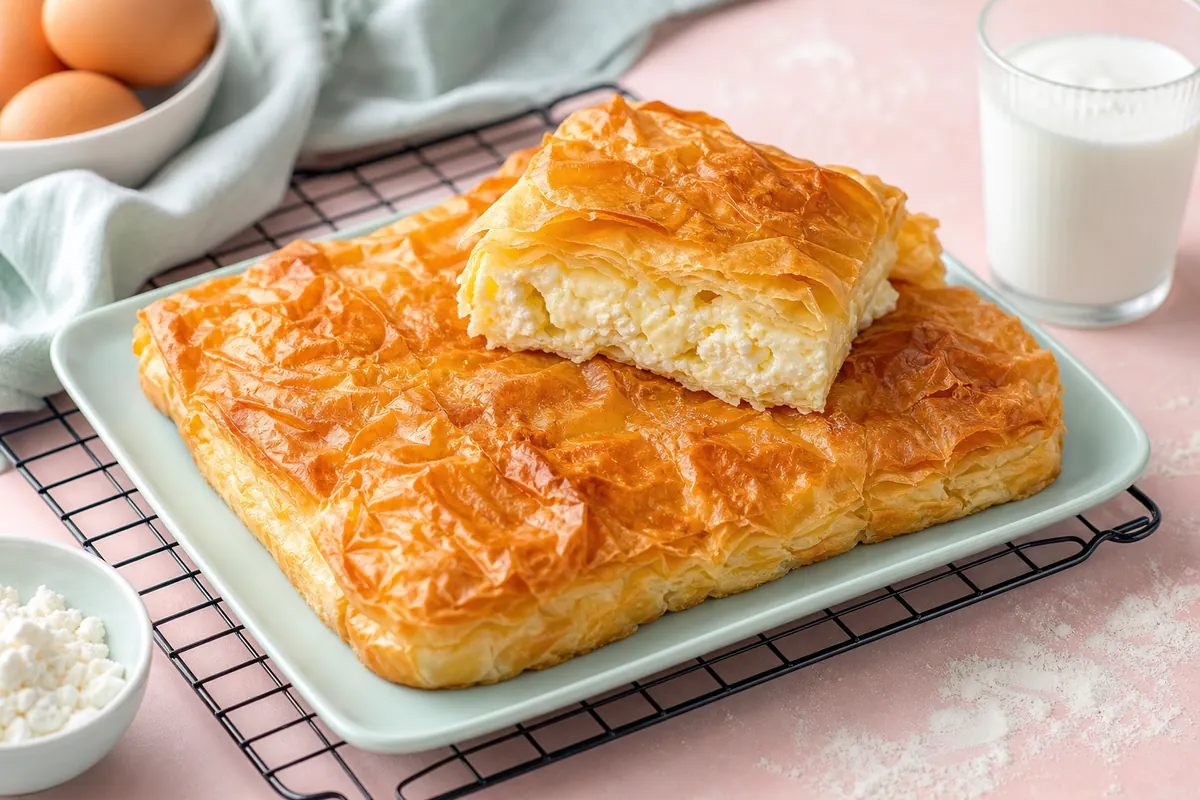
Banitsa, a pie of crisp filo layers, is the breakfast of Bulgaria. Sold warm from bakery windows in the morning and eaten on the move with a cup of boza or ayran, it is also a festive dish, made at home for holidays and family gatherings. At its simplest it is layers of thin pastry, called kori, with a filling of eggs, yoghurt and sirene – the brined white cheese that sits somewhere between feta and a young sheep's cheese.
New Year luck
On New Year's Eve, many Bulgarian families bake a special banitsa with kasmeti, small good-luck charms tucked between the layers. These are usually slips of paper wrapped in foil, each carrying a wish – health, travel, love, a new job – and sometimes a coin. The banitsa is cut around midnight and everyone reads the fortune in their slice. Small pieces of dogwood twig, whose buds stand for health, are another traditional addition.
Flat, twisted or crumpled
There is more than one way to assemble banitsa. The quickest is in flat layers, like a lasagne. Twisted banitsa, vita banitsa, is made by scrunching each filled sheet into a rope and coiling it in a round tin. A third approach gathers each sheet loosely into ruffles before adding it to the dish, which makes a lighter, airier pie. All three taste much the same; the difference is texture, and every family insists its way is the right one.
Bake sheet
The recipe: Bulgarian filo and cheese pie (banitsa)
- Oven
- 200°C180°C fan · gas 6
- Makes
- 8 servings
- Prep
- 25 min
- Baking
- 40 min
- Total
- 1 hr 15 min
Ingredients
Tick off each ingredient as you weigh it out.
Method
- Heat the oven to 200°C (180°C fan, gas 6). Butter a 23 x 30cm baking dish.
- Stir the bicarbonate into the yoghurt and leave for a minute to foam. Whisk in the eggs, then stir in the cheese, reserving a handful.
- Lay two filo sheets in the dish, brush with butter and spoon over some filling. Continue layering, crumpling the sheets slightly for lightness, until everything is used. Finish with two sheets of filo.
- Cut into squares, brush with the remaining butter, scatter over the reserved cheese and pour the sparkling water over the top.
- Bake for 35–40 minutes until puffed and golden. Rest for 10 minutes before serving.
The fizz and the bicarbonate
Two small tricks lighten the filling. Bicarbonate of soda is stirred into the yoghurt, where it foams as it reacts with the acid. And just before baking, many cooks pour a splash of sparkling water over the top so the pastry steams and puffs. The result is a banitsa that is crisp on top and soft, almost soufflé-like, in the middle.
Bulgarian cooks have countless family versions, with leeks, spinach, pumpkin or even milk and sugar. If you would like to explore them in Bulgarian, recept.bg offers a broad collection of home recipes to compare with this one.
Feta is the most widely available substitute for sirene in Britain, but Bulgarian sirene itself is sold in many Eastern European grocers, and its creamier, slightly tangier flavour is worth seeking out.
Serve banitsa warm rather than piping hot, so the filling has a moment to settle and slices cleanly. A glass of ayran, or simply plain yoghurt thinned with cold water and a pinch of salt, is the traditional companion. Leftovers reheat well in a low oven, and many Bulgarians would argue they are even better cold the next morning.