Guide · Lithuania
Lithuanian Tree Cake (Šakotis): Baked Layer by Layer on a Spit
Lithuania's spiky tree cake, šakotis: how it is baked layer by layer on a turning spit, its Polish and German cousins and how to serve one at a celebration.
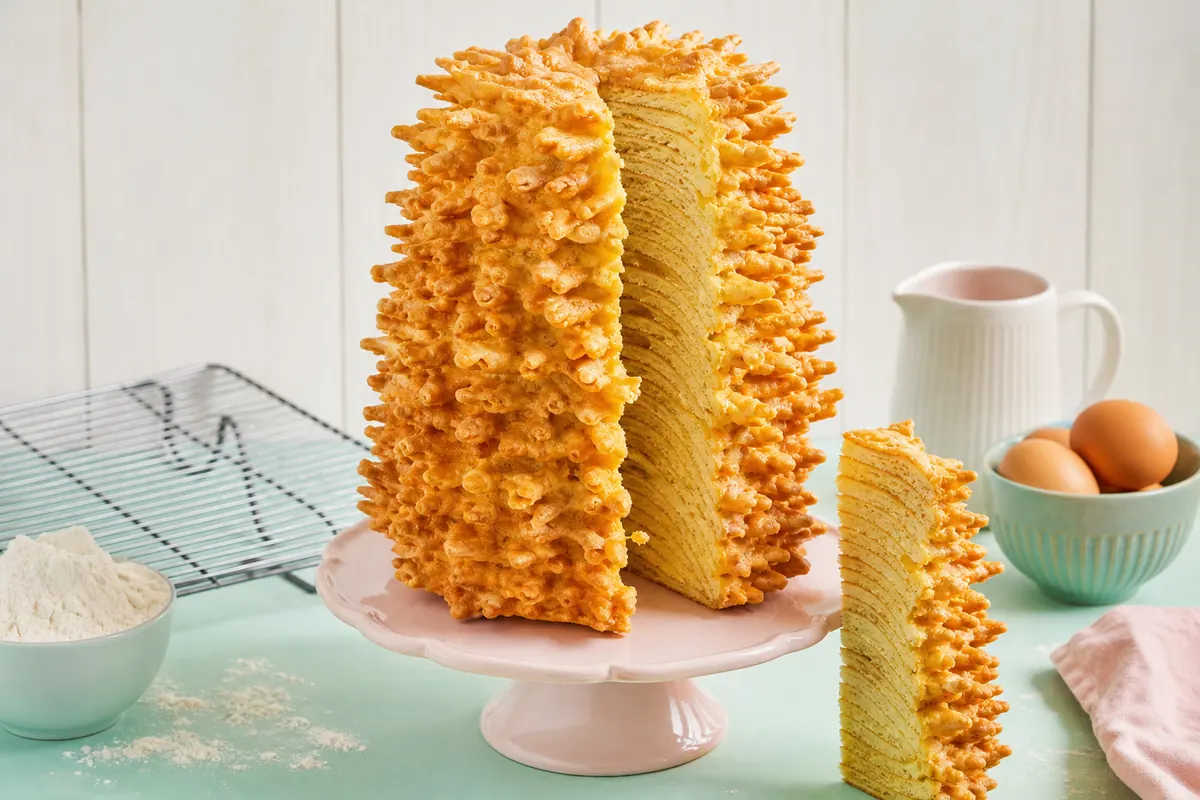
Few cakes look as dramatic as the Lithuanian tree cake, šakotis. Tall, hollow and covered in irregular golden spikes, it stands on the table like a small, sugary tree – the name comes from šaka, the Lithuanian word for branch. It is a fixture at Lithuanian weddings, christenings and anniversaries, and the grandest examples are taller than a child.
How it is made
Šakotis is not baked in an oven at all. A rich batter, made with a remarkable number of eggs together with butter, sugar, flour and cream, is poured slowly over a cone-shaped spit that turns in front of an open fire or an electric heating element. As the spit rotates, the batter sets in a thin layer. The baker ladles on more, layer after layer, and as the batter drips it sets into the characteristic branches. A large cake takes hours and constant attention, because the spit must keep turning and the batter has to be poured at exactly the right pace.
Cut a slice crosswise and you see rings, like the growth rings of a tree. The texture is fine, slightly dry and distinctly eggy, somewhere between a sponge and a biscuit. Because the many thin layers lose moisture slowly, a šakotis keeps far longer than an ordinary sponge.
Relatives across Europe
Šakotis belongs to a family of spit cakes found across central and northern Europe. In Poland, particularly in the north-east near the Lithuanian border, it is known as sękacz, a name that refers to knots in wood. Germany has Baumkuchen, the 'tree cake', built from thin layers in a similar way but usually smoother, often glazed with chocolate or fondant. All of them share the same idea: a cake grown ring by ring over heat.
Can you bake it at home?
Strictly speaking, not without a spit and a source of radiant heat. Some enthusiasts have built rotisserie rigs for exactly this purpose, but most Lithuanians buy their šakotis from specialist bakers or receive one as a gift. What you can do in an ordinary kitchen is borrow the German home trick for a Baumkuchen-style tray cake: spread a thin layer of batter in a lined tin, grill it until golden, add the next layer and repeat. It gives you the rings, though not the branches.
If you want to understand what goes into the real thing, a recipe for Lithuanian šakotis written for home bakers in Lithuania shows the generous quantities of eggs and butter involved and explains the rhythm of pouring and turning.
How to serve it
At a celebration, guests often start by snapping off the crisp branches, which many consider the best part. Then the trunk is cut across into rings. Šakotis is eaten with coffee or tea, and for weddings it is frequently decorated with fresh flowers or ribbons. If you are given one, keep it wrapped at cool room temperature rather than in the fridge, where it dries out faster.
It also travels remarkably well, which is why a boxed šakotis is a favourite present to carry home from Lithuania – sturdy, light for its size and certain to start a conversation at the table.
Lithuanian bakers sell šakotis in every size, from palm-sized pieces wrapped in cellophane to towering cakes ordered weeks in advance for weddings, and many families have a favourite maker whose cake they would not swap for any other.