Guide · Baker's notes
Why Cakes Sink in the Middle, and How to Stop It
Why cakes sink in the middle: underbaking, early door-opening, too much raising agent, overbeating and the wrong tin. Simple fixes, plus how to rescue one.
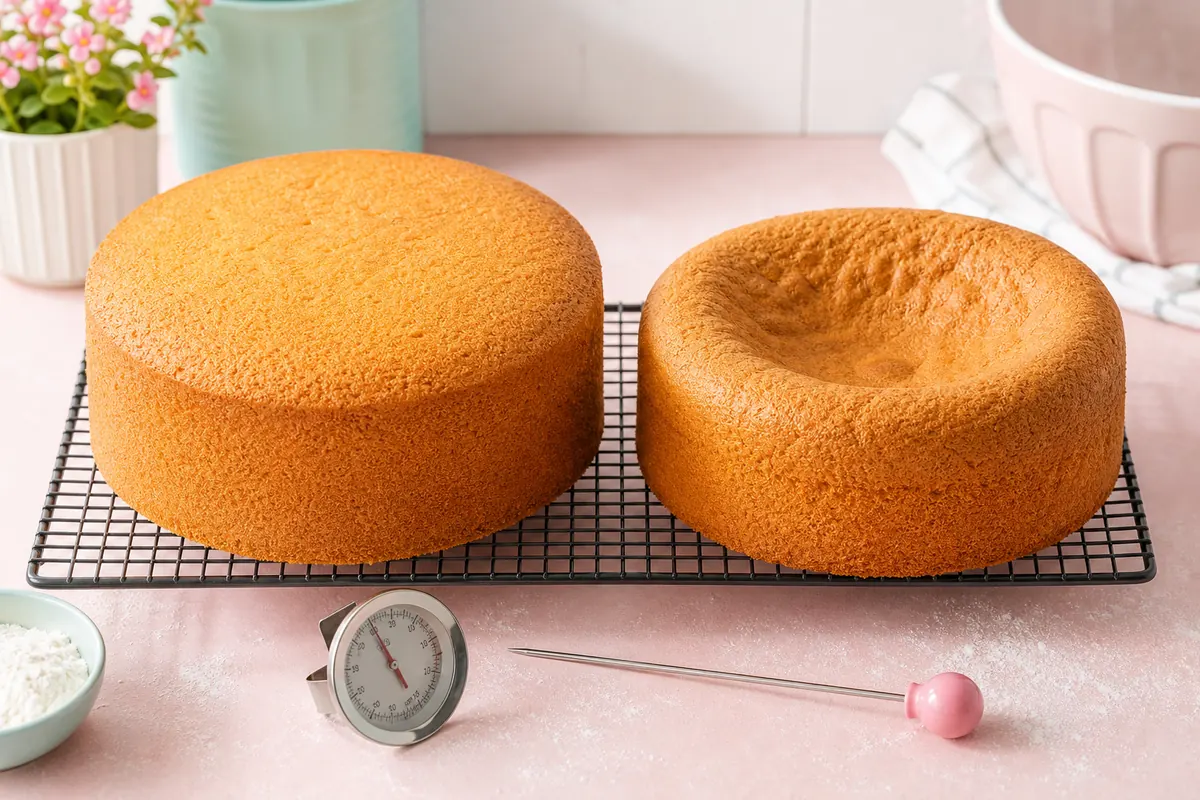
There are few kitchen moments as deflating, quite literally, as watching a beautifully risen cake slump in the middle as it cools. The good news is that a sunken cake is almost always the result of one of a handful of causes, and most of them are easy to fix.
First, how a cake rises
A cake rises because gas bubbles in the batter expand in the heat. Some of that gas is air you beat in while creaming butter and sugar or whisking eggs; the rest comes from baking powder or bicarbonate of soda, which release carbon dioxide. Meanwhile, the heat sets the egg proteins and the flour's starch, firming the structure around those bubbles. A cake sinks when the bubbles expand faster than the structure can set, or when the structure is too weak to hold them as the cake cools.
The usual suspects
Underbaking
The most common cause by far. If the centre has not set, it collapses as the steam inside condenses. A skewer pushed into the middle should come out clean, and the top should spring back when pressed gently. Many ovens run cooler than their dial suggests, and an inexpensive oven thermometer will tell you the truth.
Opening the door too early
A rush of cool air in the first two-thirds of the baking time can halt a cake mid-rise, before its structure has set. Keep the door closed until at least three-quarters of the stated time has passed, and use the oven light instead.
Too much raising agent
It seems logical that more baking powder means more lift, but excess gas makes bubbles grow too large, merge and escape, so the cake rises dramatically and then falls. Use proper measuring spoons, levelled off, and do not add baking powder to self-raising flour unless the recipe asks for it.
Overbeating
Vigorous beating after the flour goes in develops gluten and can trap too much air. A cake made this way may balloon in the oven and then deflate. Fold the flour in gently, only until no streaks remain.
Too much sugar or liquid
Sugar weakens structure, because it competes with the flour for water and delays the setting of the eggs. Small changes – an extra spoonful of syrup, a heaped rather than level measure, a splash more milk – can tip the balance.
The wrong tin
A tin that is too small makes a deep batter whose centre takes far longer to set than its edges. If you must swap tins, adjust the baking time and test carefully.
Tired baking powder
Baking powder loses strength over time, especially once opened. Stir half a teaspoon into hot water: it should fizz vigorously. Weak powder gives a dense cake that may dip as well.
Rescuing a sunken cake
A sunken sponge is still a delicious sponge. Trim the edges level with the dip and fill the hollow with whipped cream and berries, break it into a trifle, or cut it into squares and serve it warm with custard. Nobody needs to know.
A quick checklist
- Eggs and butter at room temperature.
- Oven fully preheated and checked with a thermometer.
- Raising agents measured precisely and in date.
- Door kept shut for three-quarters of the baking time.
- Centre tested with a skewer before the cake comes out.